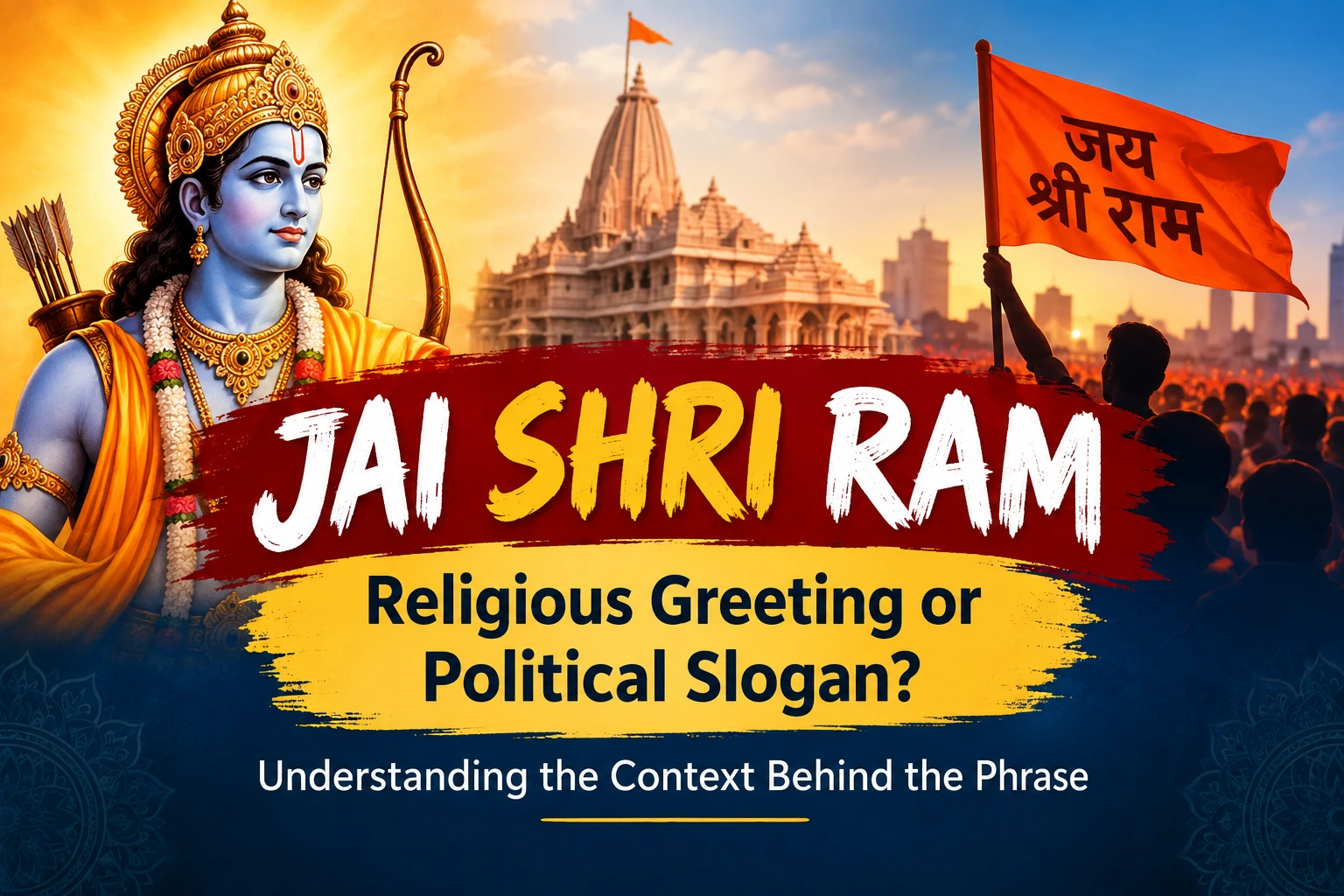
“Jai Shri Ram” is one of the most familiar religious expressions in India. The phrase refers to Lord Ram, an important figure in Hindu tradition. In simple words, “Jai Shri Ram” means “Victory to Lord Ram.”
For many people, the phrase is mainly a religious or devotional greeting. People may say it while praying, meeting other devotees, attending religious events, or expressing their faith. In this use, the phrase is connected with devotion and respect for Lord Ram.
However, the phrase also has an important place in modern Indian politics. During the Ram Janmabhoomi movement and the political debates surrounding Ayodhya, “Jai Shri Ram” became widely used at rallies, marches, and public gatherings. Because of this history, the phrase is now sometimes strongly connected with political movements and political identity.
This does not mean that every person who says “Jai Shri Ram” is making a political statement. The same words can have different meanings depending on where and why they are spoken.
For example, if someone says “Jai Shri Ram” during a religious ceremony, it may simply be an expression of faith. If the phrase is shouted at a political rally, it may work as a political slogan. In another situation, someone may use it as a traditional greeting without intending any political message.
The phrase has therefore become an example of how religion, culture, and politics can sometimes overlap in public life. Words that begin as religious expressions can become part of wider social and political discussions over time.
It is also important to remember that people may understand the phrase differently. For some, it represents devotion and religious identity. For others, its political use is more noticeable because of its association with political campaigns and public movements.
So, is “Jai Shri Ram” a religious greeting or a political slogan?
The most accurate answer is: it can be either, depending on the context. Its original and continuing use is religious and devotional, but it has also been widely used as a political slogan in modern India.
Understanding the context is important. Instead of assuming that the phrase always has one fixed meaning, it is better to look at who is saying it, where it is being said, and what the purpose is.
In a diverse country like India, discussions about religious expressions and political slogans can sometimes be sensitive. A balanced understanding helps people discuss such topics respectfully while recognizing the different meanings a phrase can have for different people.
Choose an image
Featured Article

For years, the default expectation after Class 12, especially for science students has been simple: clear JEE for engineering or clear NEET for medicine. If you didn't fit into those two boxes, it often felt like you were out of options. How to Choose the Right Path.
That narrative is completely outdated. Read More

What if the world's largest river wasn't on the ground?
When people think of the Amazon, they imagine a vast jungle filled with exotic wildlife, giant trees, and the mighty Amazon River. But scientists have discovered something even more astonishing hidden above the forest. A massive invisible rivers flowing through the sky. Read More
বৃক্ষছায়ায় জ্ঞানের আলোকবর্তিকা: প্রাচীন ভারতীয় শিক্ষা দর্শনের গূঢ়তত্ত্ব Read More

A brief overview of the village where Batukeshwar Dutt was born, its historical significance and how to visit. Read More

অনেক বছর ধরে প্রচলিত একটি ধারণা মানুষ তার মস্তিষ্কের মাত্র ১০% ব্যবহার করে। আধুনিক স্নায়ুবিজ্ঞান বলছে, এটি সম্পূর্ণ ভুল। আমরা আসলে আমাদের মস্তিষ্কের প্রায় সব অংশই ব্যবহার করি, শুধু একসঙ্গে নয়। প্রতিটি অঞ্চল নির্দিষ্ট কাজের জন্য দায়ী, কোনো অংশ ভাষা বোঝে, কোনো অংশ পরিকল্পনা করে, আবার অন্য অংশ আবেগ বা চলাফেরার নিয়ন্ত্রণে থাকে। Read More