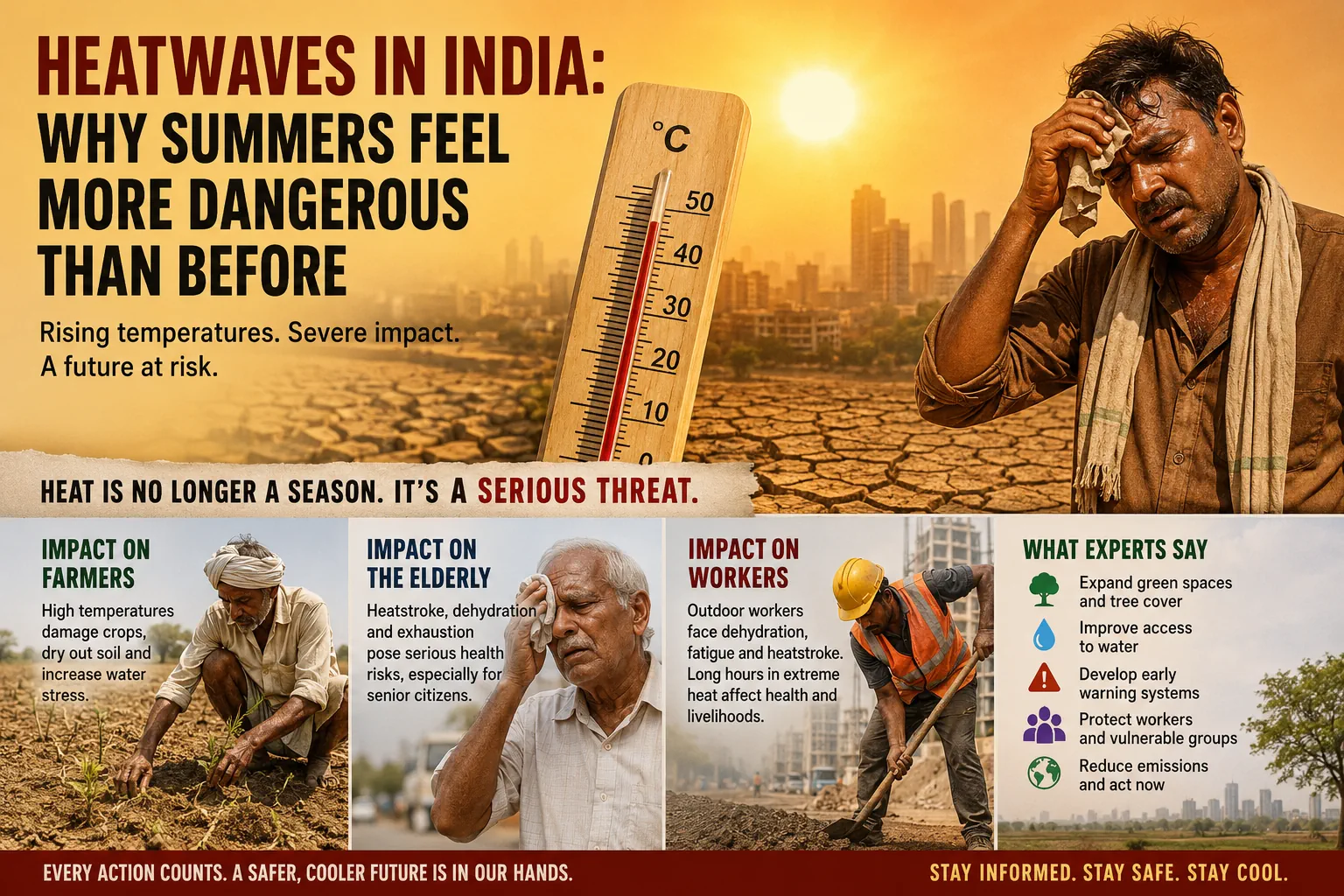
The summer of 2026 has once again reminded Indians that extreme heat is no longer an occasional inconvenience, it is becoming a serious threat to daily life. Across many parts of the country, people are waking up to scorching mornings, struggling through unbearable afternoons, and finding little relief even after sunset. What once felt like a few particularly hot days now seems to stretch across entire weeks.
The question many people are asking is simple:
Why do summers feel so much more dangerous now than they did a decade ago?
A Summer That Feels Different
Anyone who has spent years living in India can notice the change. Temperatures above 40°C are becoming more common, but the real issue is not just the number on the thermometer. The heat now lasts longer, arrives earlier, and often combines with high humidity, making conditions feel even more oppressive.
In cities, roads and buildings absorb heat throughout the day and release it slowly at night. As a result, many urban residents experience restless nights and continuous exposure to high temperatures. For people without air conditioning, escaping the heat can be nearly impossible.
Climate Change Is No Longer a Distant Issue
For years, climate change was discussed as a future problem. Today, it is increasingly visible in everyday life.
Scientists around the world have repeatedly warned that rising global temperatures would increase the frequency and intensity of heatwaves. The extreme weather being experienced across India is consistent with those predictions. While no single heatwave can be blamed entirely on climate change, experts agree that global warming is making such events more likely and more severe.
The warming atmosphere traps more heat, creating conditions where record temperatures are broken more often than in previous generations.
Farmers Are Feeling the Pressure
For Indian farmers, extreme heat is more than discomfort-- it directly affects livelihoods.
Many crops are sensitive to temperature changes during critical growth stages. Prolonged heat can reduce yields, increase water demand, and damage soil quality. Farmers in several regions have reported concerns about declining productivity and rising irrigation costs.
At a time when many agricultural communities are already dealing with uncertain rainfall patterns, heatwaves add another layer of risk. Lower production can eventually affect food prices, creating challenges not only for farmers but also for consumers.
The Hidden Crisis for Workers
One of the most visible impacts of recent heatwaves is on outdoor workers.
Construction labourers, delivery riders, street vendors, sanitation workers, and agricultural labourers often spend hours under direct sunlight. Unlike office employees, many cannot simply move indoors when temperatures become dangerous.
Doctors and public health experts warn that prolonged exposure can lead to dehydration, exhaustion, and heatstroke. Yet for many workers, taking time off means losing income. This creates a difficult choice between health and financial survival.
Why the Elderly Face Greater Risks
Older adults remain among the most vulnerable during extreme heat events.
Many elderly people already live with heart disease, diabetes, or respiratory conditions. High temperatures place additional stress on the body and can worsen existing health problems. Dehydration can develop quickly, particularly among those living alone.
Hospitals often see an increase in heat-related illnesses during prolonged hot spells, especially when temperatures remain high both day and night.
Experts Say Adaptation Can No Longer Wait
Climate experts increasingly argue that India must treat heatwaves as a major public health challenge rather than simply a seasonal weather event.
Several cities have introduced heat action plans, public advisories, and early warning systems. Experts also recommend expanding urban green spaces, improving access to drinking water, increasing shaded public areas, and protecting outdoor workers during peak heat hours.
At the same time, they stress that long-term solutions require addressing the broader causes of climate change through cleaner energy, sustainable development, and reduced greenhouse gas emissions.
A New Reality for India
The intense heat being experienced today is not just another hot summer. It reflects a changing climate that is already affecting health, agriculture, productivity, and quality of life.
For many Indians, the danger is no longer theoretical. It is felt in dried-up fields, crowded hospitals, exhausting workdays, and sleepless nights.
As summers continue to grow hotter, the challenge facing India is not only how to survive the next heatwave, but how to adapt to a future in which extreme heat may become the new normal.
Choose an image
Featured Article

For years, the default expectation after Class 12, especially for science students has been simple: clear JEE for engineering or clear NEET for medicine. If you didn't fit into those two boxes, it often felt like you were out of options. How to Choose the Right Path.
That narrative is completely outdated. Read More
What if the world's largest river wasn't on the ground?
When people think of the Amazon, they imagine a vast jungle filled with exotic wildlife, giant trees, and the mighty Amazon River. But scientists have discovered something even more astonishing hidden above the forest. A massive invisible rivers flowing through the sky. Read More
বৃক্ষছায়ায় জ্ঞানের আলোকবর্তিকা: প্রাচীন ভারতীয় শিক্ষা দর্শনের গূঢ়তত্ত্ব Read More

A brief overview of the village where Batukeshwar Dutt was born, its historical significance and how to visit. Read More

অনেক বছর ধরে প্রচলিত একটি ধারণা মানুষ তার মস্তিষ্কের মাত্র ১০% ব্যবহার করে। আধুনিক স্নায়ুবিজ্ঞান বলছে, এটি সম্পূর্ণ ভুল। আমরা আসলে আমাদের মস্তিষ্কের প্রায় সব অংশই ব্যবহার করি, শুধু একসঙ্গে নয়। প্রতিটি অঞ্চল নির্দিষ্ট কাজের জন্য দায়ী, কোনো অংশ ভাষা বোঝে, কোনো অংশ পরিকল্পনা করে, আবার অন্য অংশ আবেগ বা চলাফেরার নিয়ন্ত্রণে থাকে। Read More