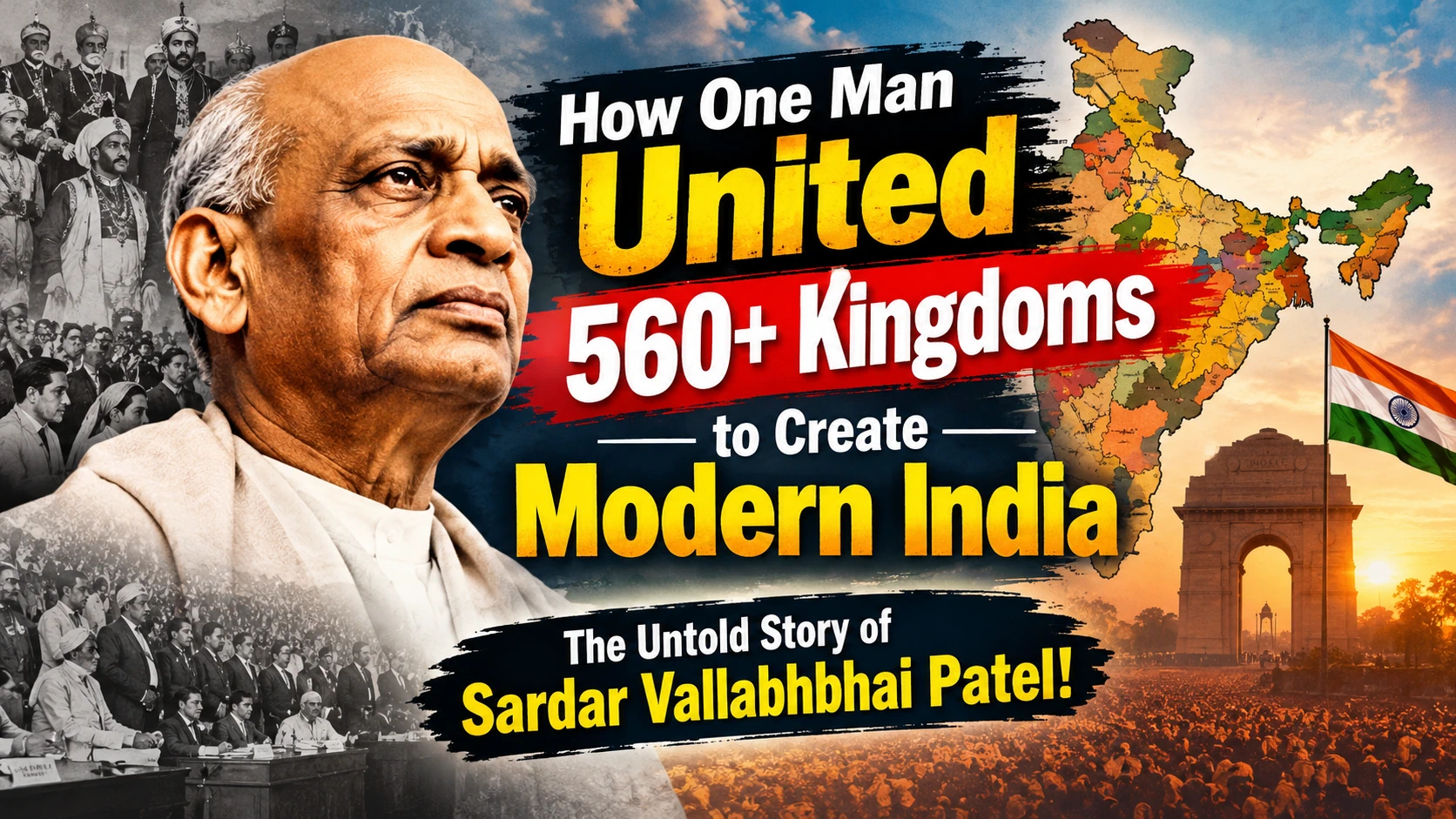
When India became independent on 15 August 1947, people across the country celebrated their freedom from British rule. But independence did not mean that India had become a fully united country. At that time, hundreds of small and large kingdoms still existed across the country. Each kingdom had its own king, ruler and administration. Bringing all these kingdoms together was a huge challenge. One man played a major role in making this possible. His name was Sardar Vallabhbhai Patel, popularly known as the Iron Man of India.
India Before Independence
Before 1947, India was divided into two types of territories. Some areas were directly ruled by the British, while others were controlled by Indian kings and princes. These kingdoms were known as princely states. There were more than 560 such states, and they were different in size, wealth and power. When the British left India, these rulers had to decide what they wanted to do. They could join India, join Pakistan or try to remain independent. This created a serious problem for the newly independent country.
Who Was Sardar Vallabhbhai Patel?
Sardar Vallabhbhai Patel was born on 31 October 1875 in Gujarat. He was a lawyer and an important leader of India's freedom movement. He worked closely with Mahatma Gandhi and took part in several movements against British rule. His leadership during the Bardoli Satyagraha made him famous, and people began calling him Sardar. After independence, he became India's first Deputy Prime Minister and Home Minister. He understood that India could not become a strong country unless all its regions came together.
The Mission to Unite India
Patel took responsibility for bringing the princely states into the Indian Union. He knew that convincing hundreds of kings would not be easy. Many rulers were worried about losing their kingdoms, wealth and power. Instead of using force everywhere, Patel first tried to solve the problem through discussion and peaceful negotiations. He explained that joining India would be better for the future of their people and their kingdoms.
The Role of V. P. Menon
Patel received valuable support from V. P. Menon, an experienced government officer. Menon worked closely with him and helped prepare important documents and negotiate with the rulers. Together, they encouraged the kings to sign an agreement called the Instrument of Accession. Through this agreement, the princely states agreed to join India in important matters such as defence, foreign affairs and communications. Most rulers accepted the proposal, and the process moved forward successfully.
Junagadh: A Kingdom That Wanted to Join Pakistan
Junagadh was a princely state in present-day Gujarat. Its ruler, Nawab Mahabat Khan, decided to join Pakistan in 1947, even though most of the people living there were Hindu and the state was surrounded by Indian territory. This decision created a serious problem. Many local people opposed the Nawab's decision. After the Nawab left for Pakistan, India took control of the situation. In February 1948, a public vote was held, and the people overwhelmingly supported joining India. Junagadh became part of the Indian Union.
Hyderabad: The Biggest Challenge
Hyderabad was one of the largest and richest princely states in India. It was ruled by the Nizam, who wanted Hyderabad to remain an independent country. But Hyderabad was located deep inside Indian territory, so its independence could create serious problems for India. Discussions between the Indian government and the Nizam did not solve the issue. The situation became more difficult because of violence and unrest involving the Razakars, an armed group supporting the Nizam. Finally, in September 1948, the Indian Army launched Operation Polo. Within a few days, Hyderabad's forces surrendered, and the state became part of India.
Jammu and Kashmir: A Different Story
Jammu and Kashmir was another important princely state. It was ruled by Maharaja Hari Singh, who initially wanted to remain independent. However, in October 1947, armed tribal forces entered Kashmir from the direction of Pakistan. The Maharaja asked India for military help. India agreed after he signed the Instrument of Accession on 26 October 1947. Indian troops were sent to Kashmir, and a war between India and Pakistan followed. Unlike other princely states, Kashmir's political situation remained complicated for many years.
Why Was Patel Called the Iron Man of India?
Patel was known for his strong determination, courage and leadership. He faced the difficult task of uniting a divided country at a time when India was also dealing with Partition, violence and economic problems. He remained focused on his goal and played a major role in bringing hundreds of princely states into the Indian Union. His contribution helped create the foundation of a united India. This is why he is remembered as the Iron Man of India.
The Statue of Unity: A Tribute to a Great Leader
To honour Sardar Vallabhbhai Patel, the Statue of Unity was inaugurated on 31 October 2018 in Gujarat. It stands 182 metres tall and is the world's tallest statue. The monument represents Patel's contribution to national unity and reminds people of his important role in shaping modern India.
India's independence was a historic achievement, but bringing the country together was another enormous task. Sardar Vallabhbhai Patel played a leading role in making that possible. With the support of V. P. Menon and other leaders, he helped unite more than 560 princely states and build a stronger Indian Union. Today, we can travel across most of India without crossing borders between hundreds of separate kingdoms. This unity is one of the greatest contributions of Patel to the nation. His life teaches us that determination, courage and strong leadership can help overcome even the biggest challenges.
Choose an image
Featured Article

For years, the default expectation after Class 12, especially for science students has been simple: clear JEE for engineering or clear NEET for medicine. If you didn't fit into those two boxes, it often felt like you were out of options. How to Choose the Right Path.
That narrative is completely outdated. Read More
What if the world's largest river wasn't on the ground?
When people think of the Amazon, they imagine a vast jungle filled with exotic wildlife, giant trees, and the mighty Amazon River. But scientists have discovered something even more astonishing hidden above the forest. A massive invisible rivers flowing through the sky. Read More
বৃক্ষছায়ায় জ্ঞানের আলোকবর্তিকা: প্রাচীন ভারতীয় শিক্ষা দর্শনের গূঢ়তত্ত্ব Read More
A brief overview of the village where Batukeshwar Dutt was born, its historical significance and how to visit. Read More

অনেক বছর ধরে প্রচলিত একটি ধারণা মানুষ তার মস্তিষ্কের মাত্র ১০% ব্যবহার করে। আধুনিক স্নায়ুবিজ্ঞান বলছে, এটি সম্পূর্ণ ভুল। আমরা আসলে আমাদের মস্তিষ্কের প্রায় সব অংশই ব্যবহার করি, শুধু একসঙ্গে নয়। প্রতিটি অঞ্চল নির্দিষ্ট কাজের জন্য দায়ী, কোনো অংশ ভাষা বোঝে, কোনো অংশ পরিকল্পনা করে, আবার অন্য অংশ আবেগ বা চলাফেরার নিয়ন্ত্রণে থাকে। Read More