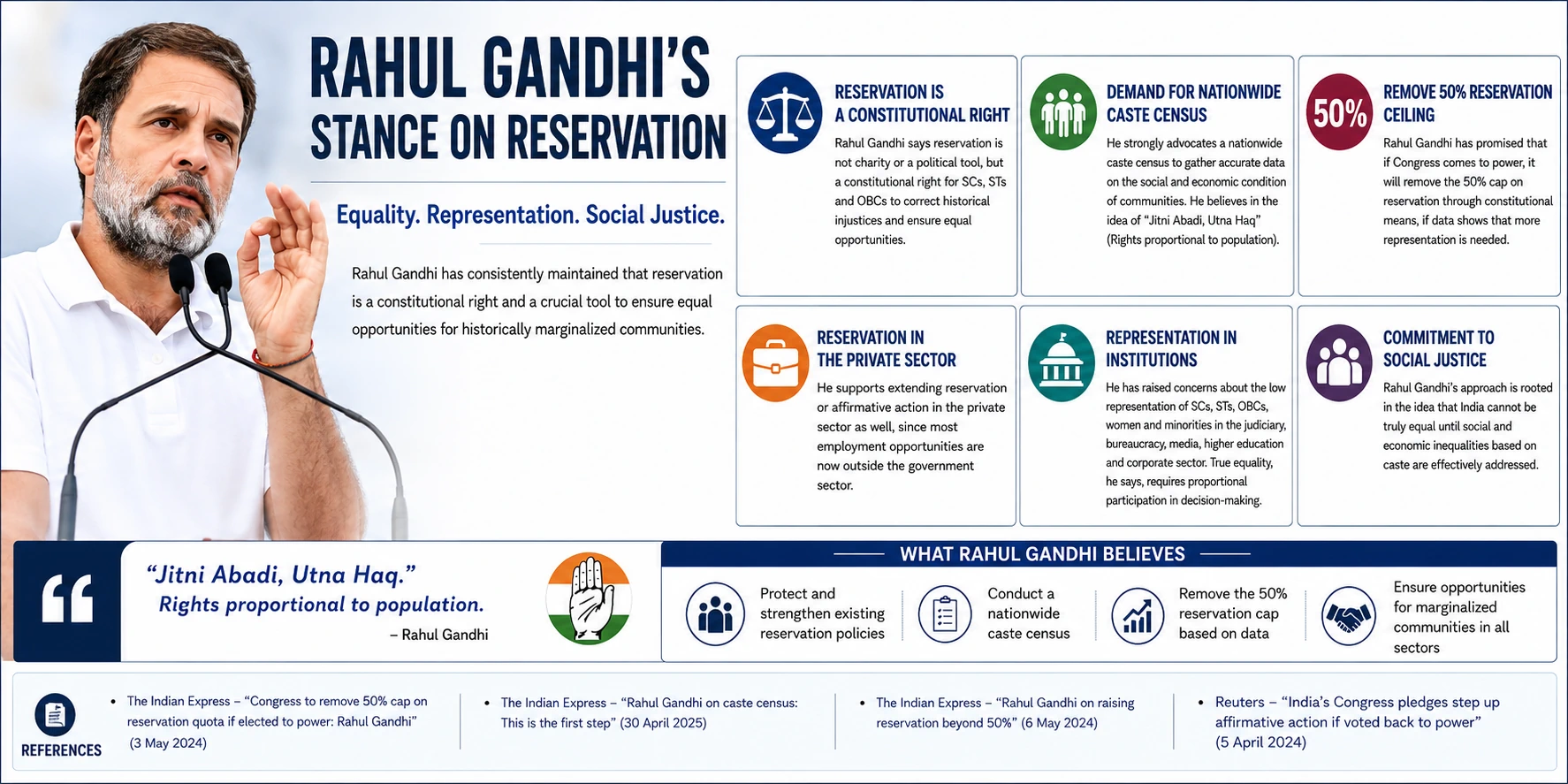
Reservation remains one of the most significant issues in Indian politics, with debates focusing on equality, representation, and constitutional rights. Congress leader and Leader of the Opposition Rahul Gandhi has consistently maintained that reservation is a constitutional mechanism to address historical discrimination and ensure equal opportunities for marginalized communities.
Reservation as a Constitutional Right
Rahul Gandhi has repeatedly stated that reservation is not a charity or a political concession but a constitutional right for historically disadvantaged communities, including Scheduled Castes (SCs), Scheduled Tribes (STs), and Other Backward Classes (OBCs). According to him, caste-based inequalities continue to affect access to education, government employment, and decision-making institutions.
Demand for a Nationwide Caste Census
One of Rahul Gandhi's central demands has been the implementation of a nationwide caste census. He argues that policymaking should be based on reliable data about the social and economic conditions of various communities.
Following the Union Cabinet's 2025 decision to include caste enumeration in the national census, Rahul Gandhi welcomed the move but demanded a clear timeline and budget for its implementation. He described caste enumeration as only the "first step" toward ensuring equitable representation.
Removing the 50% Reservation Ceiling
Rahul Gandhi has consistently argued that the Supreme Court's 50% cap on reservations should be reconsidered if empirical data from a caste census shows that disadvantaged communities require greater representation.
During the 2024 Lok Sabha election campaign, he announced that the Congress would seek to remove the 50% ceiling on reservations through constitutional means if elected to power.
"Jitni Abadi, Utna Haq"
Rahul Gandhi has popularized the slogan "Jitni Abadi, Utna Haq" ("Rights proportional to population"), arguing that representation in education, public employment, and institutions should reflect the demographic composition of the country. He believes a caste census would provide the factual basis for assessing whether marginalized communities receive fair representation.
Reservation Beyond Government Jobs
Rahul Gandhi has also advocated extending affirmative action to the private sector. He has argued that as private companies now account for a large share of employment, discussions on reservation should not remain limited to government jobs and educational institutions.
Representation in Institutions
Beyond reservation, Rahul Gandhi has frequently raised concerns about the underrepresentation of SCs, STs, OBCs, women, and other marginalized communities in the judiciary, bureaucracy, media, higher education, and corporate leadership. According to him, equal participation in decision-making institutions is essential for strengthening Indian democracy.
Political Debate
The Bharatiya Janata Party (BJP) has criticized Rahul Gandhi's proposals, arguing that they could increase caste-based politics and social divisions. The Congress, however, maintains that caste-based data and stronger reservation policies are necessary to achieve substantive equality and fulfill the constitutional promise of social justice.
Conclusion
Rahul Gandhi's position on reservation is centered on four key principles:
- Protect existing constitutional reservations.
- Conduct a nationwide caste census.
- Remove the 50% reservation cap based on empirical evidence.
- Expand representation for marginalized communities in both public and private sectors.
Supporters view these proposals as measures to advance social justice and equal opportunity, while critics argue they may deepen identity-based politics. The debate continues to be one of the defining issues in contemporary Indian politics.
References
- The Indian Express – Rahul Gandhi on caste census and reservation (April 30, 2025)
- The Indian Express – Congress to remove 50% cap on reservation (May 3, 2024)
- The Indian Express – Rahul Gandhi on raising reservation beyond 50% (May 6, 2024)
- Reuters – Congress manifesto on reservation and caste census
- Rahul Gandhi's 2023 Parliament speech on Women's Reservation and Caste Census (YouTube)
Choose an image
Featured Article

For years, the default expectation after Class 12, especially for science students has been simple: clear JEE for engineering or clear NEET for medicine. If you didn't fit into those two boxes, it often felt like you were out of options. How to Choose the Right Path.
That narrative is completely outdated. Read More

What if the world's largest river wasn't on the ground?
When people think of the Amazon, they imagine a vast jungle filled with exotic wildlife, giant trees, and the mighty Amazon River. But scientists have discovered something even more astonishing hidden above the forest. A massive invisible rivers flowing through the sky. Read More
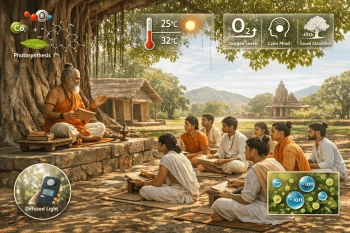
বৃক্ষছায়ায় জ্ঞানের আলোকবর্তিকা: প্রাচীন ভারতীয় শিক্ষা দর্শনের গূঢ়তত্ত্ব Read More
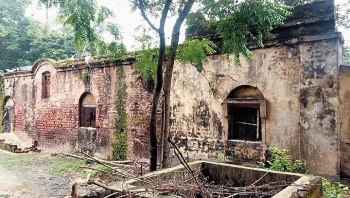
A brief overview of the village where Batukeshwar Dutt was born, its historical significance and how to visit. Read More

অনেক বছর ধরে প্রচলিত একটি ধারণা মানুষ তার মস্তিষ্কের মাত্র ১০% ব্যবহার করে। আধুনিক স্নায়ুবিজ্ঞান বলছে, এটি সম্পূর্ণ ভুল। আমরা আসলে আমাদের মস্তিষ্কের প্রায় সব অংশই ব্যবহার করি, শুধু একসঙ্গে নয়। প্রতিটি অঞ্চল নির্দিষ্ট কাজের জন্য দায়ী, কোনো অংশ ভাষা বোঝে, কোনো অংশ পরিকল্পনা করে, আবার অন্য অংশ আবেগ বা চলাফেরার নিয়ন্ত্রণে থাকে। Read More