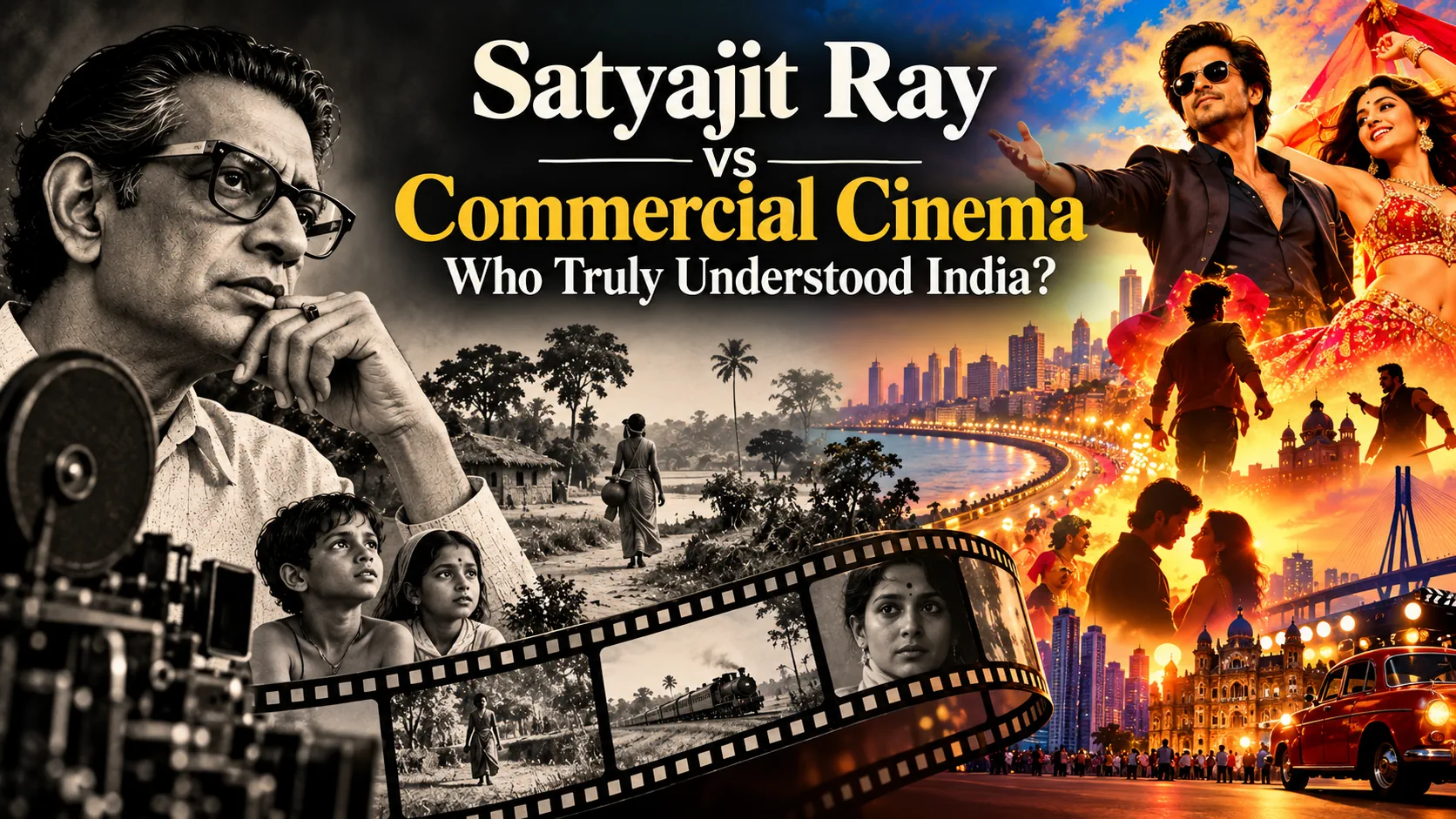
Indian cinema has always been more than entertainment. It is a reflection of the country's dreams, fears, traditions, contradictions and changing social realities. Yet, throughout its history, filmmakers have approached this responsibility in very different ways. Some have built spectacular worlds filled with romance, action, music and larger-than-life heroes. Others have turned their cameras towards ordinary people and the quiet struggles of everyday life.
Few filmmakers represent the second approach as powerfully as Satyajit Ray.
But an intriguing question remains: Did Satyajit Ray understand India better than commercial cinema did? Or did mainstream filmmakers capture another equally important side of the Indian experience?
The answer requires us to look beyond box-office collections, international awards and popular heroes, and examine what cinema tells us about the country we live in.
Satyajit Ray: India Beyond the Screen's Glamour
When Satyajit Ray made Pather Panchali in 1955, he introduced audiences to a world far removed from the glamour traditionally associated with mainstream cinema. His film followed a poor rural Bengali family, capturing its hardships, relationships, small joys and devastating losses.
There were no invincible heroes, spectacular fight sequences or convenient solutions to life's problems. Instead, Ray invited viewers to observe life as it unfolded.
A child's curiosity, a mother's exhaustion, an elderly woman's loneliness and the excitement of seeing a train passing through the countryside became powerful cinematic moments.
What made Ray remarkable was not simply that he showed poverty. It was that he showed people living within it.
His characters were never merely symbols of deprivation. They had dreams, weaknesses, desires, humour and dignity. Their lives mattered even when the world around them offered little hope.
Through the Apu Trilogy— Pather Panchali, Aparajito and Apur Sansar, Ray explored childhood, education, ambition, loss, marriage and the complicated transition from village life to the modern city.
These were not exclusively Bengali experiences. They reflected universal human emotions within a distinctly Indian social setting.
Commercial Cinema: The India of Dreams and Aspirations
Mainstream commercial cinema has often been criticised for exaggeration, melodrama and unrealistic portrayals of society. Its heroes can survive impossible situations, its romances overcome extraordinary obstacles, and its villains conveniently embody everything wrong with the world.
Yet dismissing commercial cinema as an inaccurate representation of India would be a mistake.
For millions of Indians, cinema is not primarily a sociological document. It is an escape from the pressures of everyday life. A film offers laughter after a difficult day, hope during uncertain times and the pleasure of seeing ordinary frustrations transformed into extraordinary victories.
Commercial cinema understands this emotional need.
Its songs, dramatic confrontations, family conflicts and triumphant endings often reflect the aspirations of audiences who want to imagine a world in which justice eventually prevails.
The poor hero who defeats a powerful businessman, the woman who challenges a restrictive family, or the individual who rises against corruption may not represent everyday reality. However, these stories can express genuine social desires.
Commercial cinema therefore captures an important part of India: not always the country as it exists, but the country people hope it might become.
Two Different Indias: Reality and Aspiration
The central difference between Ray and mainstream commercial filmmakers lies in their storytelling priorities.
Ray often explored the tension between personal dreams and social circumstances. His characters could not simply defeat poverty, tradition or grief through determination alone. Life was complicated, and progress frequently came with sacrifice.
Commercial cinema, by contrast, has often transformed these same struggles into dramatic conflicts with emotionally satisfying resolutions.
Consider the difference between a poor family struggling to survive and a poor protagonist who eventually becomes wealthy. Both stories may begin with economic hardship, but they offer different interpretations of it.
The first asks the audience to understand the experience of poverty. The second may invite the audience to imagine escaping it.
Neither perspective is automatically meaningless. One develops empathy through observation; the other can offer hope through imagination.
However, problems arise when commercial cinema repeatedly presents wealth as the ultimate measure of success, romanticises inequality or suggests that individual determination alone can overcome deeply rooted social barriers.
Ray's cinema frequently left viewers with uncomfortable questions rather than easy answers.
Did Ray Understand Rural India Better?
Ray's portrayal of rural Bengal remains one of the most compelling examples of social realism in Indian cinema.
In Pather Panchali, the village is neither an idyllic paradise nor a miserable landscape designed merely to evoke sympathy. It is a living environment where beauty and hardship exist together.
Children discover the world around them. Families struggle with limited resources. Nature offers wonder but can also bring suffering. The ordinary becomes meaningful because the filmmaker pays attention to it.
Ray understood that poverty was not simply the absence of money. It affected relationships, opportunities, dignity and the choices available to individuals.
His achievement was to make audiences look closely at people whose lives could easily be overlooked.
Nevertheless, Ray should not be treated as the only filmmaker who understood rural India. Indian cinema has a rich tradition of socially conscious filmmaking, and other directors have also explored caste, class, agrarian distress, exploitation and village life.
Ray's distinction lies in the sensitivity, restraint and depth with which he approached his subjects—not in an exclusive claim to understanding the country.
The Changing Face of India: City, Class and Modernity
Ray's understanding of India extended far beyond rural poverty.
In Mahanagar (The Big City, 1963), he explored a middle-class household in Calcutta and the changing position of women in the world of work. The film examines financial insecurity, gender expectations, independence and the tensions that emerge when traditional family roles begin to change.
These questions remain relevant in contemporary India.
A woman entering the workforce, a family negotiating financial pressure, or a young person struggling between personal ambition and social expectations may experience conflicts that are strikingly familiar today.
Ray also explored the anxieties of urban youth and the moral compromises of modern professional life.
His cinema recognised that India's transformation was not merely economic. Modernisation changed relationships, identities and the ways people understood their responsibilities to family and society.
This is where Ray's work becomes particularly valuable: he did not simply record a changing India; he examined the human consequences of that change.
Where Commercial Cinema Often Falls Short
Commercial cinema is at its weakest when spectacle replaces observation and social complexity is reduced to convenient stereotypes.
Poverty becomes a backdrop for a hero's success. Women become rewards for male achievement. Villagers appear as simplistic figures, while wealth and urban lifestyles are presented as unquestionable signs of progress.
Such portrayals can narrow our understanding of a country as diverse as India.
Real life rarely divides people neatly into heroes and villains. Social problems are often shaped by institutions, economic conditions, historical inequalities and conflicting interests. They cannot always be solved by defeating a single antagonist.
Ray's films remind us that ordinary people are rarely so simple.
However, commercial cinema should not be judged entirely by its least thoughtful examples. Mainstream Indian filmmakers have also produced powerful stories about injustice, family, class, gender, national identity and social change.
Popular cinema can provoke debate as effectively as art cinema when it combines entertainment with honest observation.
The real distinction is not necessarily between films that entertain and films that educate. It is between films that deepen our understanding and films that rely on familiar assumptions without examining them.
Was Satyajit Ray More Indian Than Commercial Cinema?
This question becomes more complicated when we consider what it means to represent India.
Ray's international reputation rests partly on his ability to tell deeply local stories that resonate across cultures. His films are rooted in Bengali language, literature, landscapes, music and social relationships, yet their emotional reach extends far beyond Bengal.
But India cannot be represented by one filmmaker, one language or one cinematic style.
The country contains countless realities: rural and urban, wealthy and poor, traditional and modern, conservative and progressive. Its people seek both meaningful reflection and uncomplicated entertainment.
Mainstream cinema has helped shape popular culture, music, fashion, public imagination and collective memory. Its emotional language is also part of India's cultural identity.
Ray's cinema offers a different kind of understanding. It encourages us to look at individuals without immediately turning them into symbols, and to recognise the complexity of lives that do not fit neatly into a dramatic formula.
To claim that only Ray understood India would therefore be too simplistic. But to ignore what his films reveal about ordinary life would be equally misguided.
Conclusion: Who Truly Understood India?
Perhaps the most meaningful answer is that Satyajit Ray and commercial cinema understood different dimensions of India.
Commercial cinema has often understood the country's aspirations: its desire for justice, romance, prosperity, recognition and emotional triumph.
Ray understood something that spectacle can sometimes obscure: the quiet dignity of ordinary people, the weight of social circumstances, and the complicated relationship between individual dreams and reality.
His films do not ask us to stop dreaming. They ask us to look carefully at the world in which those dreams must survive.
That is why Ray remains relevant in an age of increasingly spectacular filmmaking. His cinema reminds us that a country is not defined only by its biggest cities, richest citizens, loudest voices or most successful heroes.
It is also defined by the lives of people who rarely occupy the centre of the screen.
If commercial cinema shows us the India we dream about, Satyajit Ray often helps us understand the India we live in. And perhaps a mature cinematic culture needs both.
The real question is not which tradition deserves to win. It is whether Indian cinema, in all its diversity, can continue to entertain us without losing its ability to help us understand ourselves.
Choose an image
Featured Article

For years, the default expectation after Class 12, especially for science students has been simple: clear JEE for engineering or clear NEET for medicine. If you didn't fit into those two boxes, it often felt like you were out of options. How to Choose the Right Path.
That narrative is completely outdated. Read More

What if the world's largest river wasn't on the ground?
When people think of the Amazon, they imagine a vast jungle filled with exotic wildlife, giant trees, and the mighty Amazon River. But scientists have discovered something even more astonishing hidden above the forest. A massive invisible rivers flowing through the sky. Read More

বৃক্ষছায়ায় জ্ঞানের আলোকবর্তিকা: প্রাচীন ভারতীয় শিক্ষা দর্শনের গূঢ়তত্ত্ব Read More

A brief overview of the village where Batukeshwar Dutt was born, its historical significance and how to visit. Read More

অনেক বছর ধরে প্রচলিত একটি ধারণা মানুষ তার মস্তিষ্কের মাত্র ১০% ব্যবহার করে। আধুনিক স্নায়ুবিজ্ঞান বলছে, এটি সম্পূর্ণ ভুল। আমরা আসলে আমাদের মস্তিষ্কের প্রায় সব অংশই ব্যবহার করি, শুধু একসঙ্গে নয়। প্রতিটি অঞ্চল নির্দিষ্ট কাজের জন্য দায়ী, কোনো অংশ ভাষা বোঝে, কোনো অংশ পরিকল্পনা করে, আবার অন্য অংশ আবেগ বা চলাফেরার নিয়ন্ত্রণে থাকে। Read More