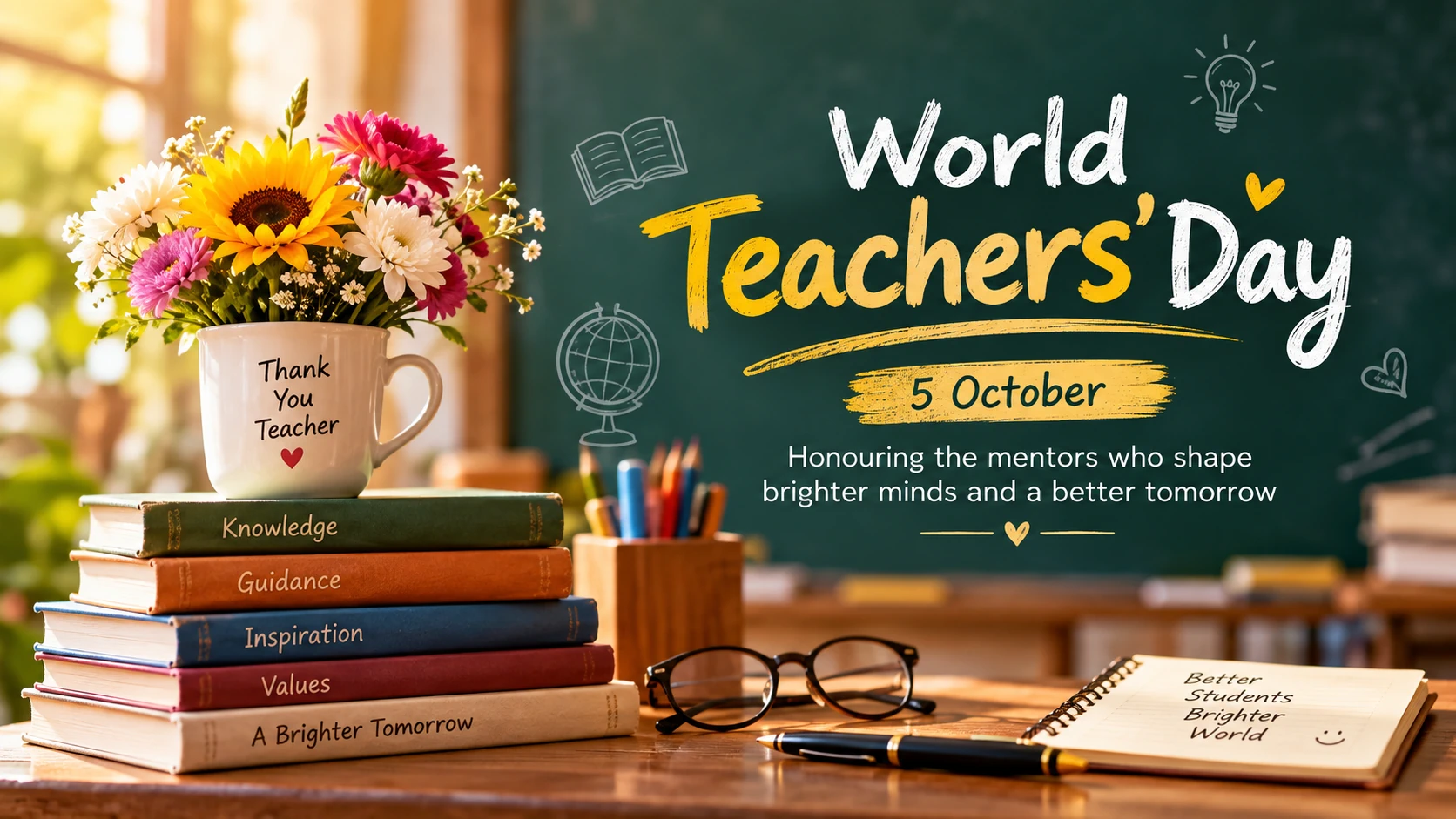
Teachers play a unique role in our lives. From teaching us our first letters and numbers to helping us understand the world around us, their influence often extends far beyond the classroom.
Every year, 5 October is observed as World Teachers’ Day. The day provides an opportunity to recognize teachers and highlight the important role they play in education and society. It also reminds us that quality education depends not only on books, technology and classrooms, but also on dedicated educators.
A good teacher does more than simply explain a lesson. Teachers encourage students to ask questions, learn from mistakes and develop confidence in their abilities. Sometimes, a few words of encouragement from a teacher can remain with a student for many years.
Why Teachers Matter
Education is one of the strongest foundations of society, and teachers are at the heart of that process. They help students develop knowledge, critical thinking, discipline, creativity and social values.
Teachers also have an important responsibility to understand that every student is different. Some learn quickly, while others need more time and encouragement. A patient teacher can help students discover their own strengths and develop a positive attitude towards learning.
Their contribution is not always measured by examination results. Teachers can influence how students think, communicate, behave and face challenges in life.
More Than a Profession
Teaching is often described as a profession, but for many educators it is also a responsibility and a commitment. Teachers spend their time preparing lessons, answering questions, correcting work and supporting students through difficulties.
Behind every successful student, there is often a teacher who provided guidance at an important moment.
A teacher may be remembered for a particular lesson, a kind word, a piece of advice or simply for believing in a student when the student lacked confidence.
Technology and the Changing Classroom
Education is changing rapidly. Digital classrooms, online learning platforms, artificial intelligence and educational technology are becoming increasingly important.
However, technology cannot completely replace the human connection between a teacher and a student. Teachers help students understand not only what to learn, but also how to think, question information and apply knowledge responsibly.
In an increasingly digital world, the role of teachers continues to evolve rather than disappear.
A Day to Say Thank You
World Teachers’ Day gives students, parents and communities an opportunity to express gratitude to educators.
A simple “Thank you, teacher” can mean a great deal. A message, a card, a conversation or even remembering a teacher who made a difference can be a meaningful way to celebrate the occasion.
Teachers help shape individuals, and individuals eventually shape society. Their work may begin inside a classroom, but its impact can continue for generations.
On this World Teachers’ Day, let us remember and appreciate every teacher who has shared knowledge, offered guidance, encouraged curiosity and helped students believe in themselves.
Happy World Teachers’ Day to all the teachers who inspire, guide and shape a brighter tomorrow.
Choose an image
Featured Article

For years, the default expectation after Class 12, especially for science students has been simple: clear JEE for engineering or clear NEET for medicine. If you didn't fit into those two boxes, it often felt like you were out of options. How to Choose the Right Path.
That narrative is completely outdated. Read More

What if the world's largest river wasn't on the ground?
When people think of the Amazon, they imagine a vast jungle filled with exotic wildlife, giant trees, and the mighty Amazon River. But scientists have discovered something even more astonishing hidden above the forest. A massive invisible rivers flowing through the sky. Read More

বৃক্ষছায়ায় জ্ঞানের আলোকবর্তিকা: প্রাচীন ভারতীয় শিক্ষা দর্শনের গূঢ়তত্ত্ব Read More

A brief overview of the village where Batukeshwar Dutt was born, its historical significance and how to visit. Read More

অনেক বছর ধরে প্রচলিত একটি ধারণা মানুষ তার মস্তিষ্কের মাত্র ১০% ব্যবহার করে। আধুনিক স্নায়ুবিজ্ঞান বলছে, এটি সম্পূর্ণ ভুল। আমরা আসলে আমাদের মস্তিষ্কের প্রায় সব অংশই ব্যবহার করি, শুধু একসঙ্গে নয়। প্রতিটি অঞ্চল নির্দিষ্ট কাজের জন্য দায়ী, কোনো অংশ ভাষা বোঝে, কোনো অংশ পরিকল্পনা করে, আবার অন্য অংশ আবেগ বা চলাফেরার নিয়ন্ত্রণে থাকে। Read More