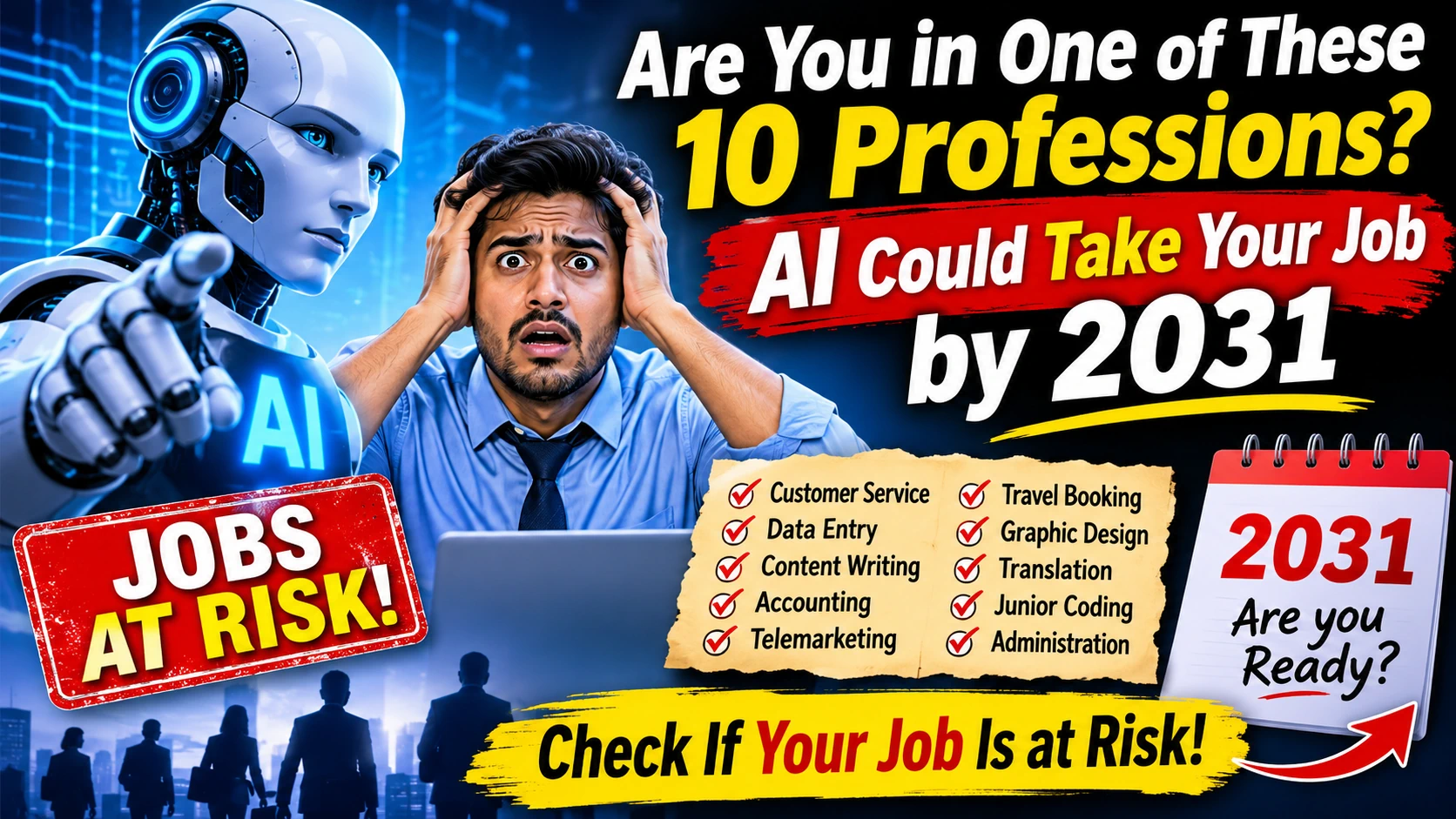
Artificial Intelligence is no longer just a futuristic technology. It is already writing content, analysing data, answering customer queries, generating images, preparing reports and performing tasks that once required hours of human work. As AI becomes cheaper, faster and more capable, one question is becoming increasingly difficult to ignore:
Could AI replace your job within the next five years?
By 2031, the workplace could look significantly different from what we know today. Not every profession will disappear, but many jobs may require fewer workers as companies increasingly rely on AI tools and automation to reduce costs and improve productivity.
The biggest threat is not necessarily that AI will eliminate an entire profession overnight. In many cases, it will replace specific tasks first, reduce hiring, shrink teams and gradually make some traditional job roles less economically viable.
Here are 10 jobs facing a serious risk of disruption over the next five years.
1. Customer Service and Call Centre Agents
Customer service is one of the areas where AI replacement is already happening. AI-powered chatbots and voice assistants can answer frequently asked questions, track orders, process refunds, troubleshoot basic problems and handle customer complaints without human intervention.
Businesses that once needed hundreds of agents to handle customer queries may increasingly rely on AI systems capable of responding to thousands of customers simultaneously.
Why this job is at risk:
Most routine customer interactions follow predictable patterns, making them easier to automate.
Risk level: Very High
2. Data Entry Operators
Data entry is among the most vulnerable jobs in the AI era. AI can extract information from documents, invoices, forms, emails and scanned files, and automatically enter it into databases and software systems.
Tasks that previously required employees to spend an entire day copying, checking and organising information can now be completed in minutes with automated tools.
Why this job is at risk:
It is repetitive, rules-based and involves structured information that AI can process at scale with minimal human intervention.
Risk level: Very High
3. Basic Content Writers and Copywriters
AI can already generate blog posts, product descriptions, SEO articles, social media captions, email newsletters and simple promotional content. Many companies that once hired several writers for routine content production may now use AI to produce first drafts with fewer employees.
This does not mean journalism, storytelling or creative writing will disappear. Original reporting, investigative work, personal experience and distinctive writing styles remain difficult to replace completely.
Why this job is at risk:
Businesses producing large volumes of ordinary, repetitive content may prefer AI-assisted production over hiring additional writers.
Risk level: High
4. Bookkeeping and Basic Accounting Clerks
AI-powered accounting software can categorise expenses, reconcile transactions, generate financial reports, process invoices and identify irregularities. Small businesses may increasingly handle routine bookkeeping with automated software instead of maintaining a large accounting team.
However, complex financial decisions, tax interpretation, auditing, legal responsibility and client advisory work still require experienced professionals.
Why this job is at risk:
A large portion of basic bookkeeping involves predictable transactions and repetitive calculations that software can automate.
Risk level: High
5. Telemarketing and Outbound Sales Representatives
AI voice agents are becoming capable of conducting conversations, introducing products, qualifying potential customers, following up on leads and scheduling appointments. In the future, businesses may use AI to contact thousands of prospective customers without employing a large telemarketing workforce.
Human salespeople will still be valuable when a deal involves trust, negotiation, emotional intelligence or complex products. But routine outbound calling could become increasingly automated.
Why this job is at risk:
AI can make repetitive calls at scale, work continuously and manage follow-ups at a lower operating cost.
Risk level: High
6. Travel Booking and Reservation Agents
Booking flights, hotels, holiday packages and transportation is becoming easier through AI assistants. A customer can simply describe a budget, destination, travel dates and preferences, and an AI agent can compare options, create itineraries and assist with reservations.
Traditional travel agents who mainly handle standard bookings may face declining demand. Agents specialising in luxury travel, complicated international trips, group tours or personalised experiences will have a better chance of surviving.
Why this job is at risk:
Most standard booking processes can be completed online and increasingly automated from start to finish.
Risk level: High
7. Basic Graphic Designers
AI image-generation tools can now create advertisements, posters, thumbnails, social media graphics, illustrations and marketing concepts in seconds. Small businesses and content creators can generate designs without hiring a designer for every project.
The greatest pressure will be on designers who mainly produce simple template-based work. Professionals with strong branding skills, artistic direction, visual storytelling and an understanding of clients will remain more valuable.
Why this job is at risk:
AI dramatically reduces the time and cost required to produce basic visual designs.
Risk level: High for basic design work
8. Basic Translators
AI translation systems can translate emails, websites, product descriptions, documents and conversations between multiple languages almost instantly. Businesses that need large volumes of ordinary translations may no longer require as many entry-level translators as they once did.
However, legal documents, literature, advertising, cultural adaptation, sensitive communications and specialised translations still require human expertise and careful review.
Why this job is at risk:
AI is increasingly capable of translating routine text with sufficient quality for everyday business use.
Risk level: High for routine translation
9. Junior Software Developers and Basic Coding Jobs
AI coding tools can generate code, create simple websites, write scripts, detect errors, explain programming problems and assist in building basic applications. This is changing the economics of software development.
Companies may need fewer people for simple coding tasks, and the expectations for junior developers could rise. Instead of only writing code, future developers may be expected to understand entire systems, test AI-generated code, identify security problems and solve complex technical issues.
Why this job is at risk:
AI can automate portions of coding, potentially reducing the need for large teams doing repetitive development tasks.
Risk level: High for routine coding, moderate for skilled developers
10. Administrative Assistants and Office Clerks
Administrative jobs often involve scheduling appointments, managing emails, preparing documents, organising records, creating reports and coordinating meetings. AI assistants are increasingly able to perform many of these tasks automatically.
As AI connects with calendars, office software, databases and communication systems, a single employee may be able to handle work that previously required several administrative staff members.
Why this job is at risk:
Many daily administrative activities are digital, predictable and can be automated through AI agents and workflow software.
Risk level: High for routine administrative roles
Which Jobs Are Most at Risk?
- Very High : Data entry, routine customer support
- High : Basic writing, bookkeeping, telemarketing, travel booking, graphic design, translation, junior coding, administration
These are qualitative risk assessments based on the nature of the work, not official predictions of job losses by 2031.
Will AI Actually Take Away These Jobs by 2031?
The honest answer is yes, AI will probably eliminate some jobs, but it will not eliminate all these professions within five years.
The speed of change will depend on the cost of AI, reliability, company adoption, customer acceptance, regulation and the availability of human workers. Some companies will replace employees. Others will use AI to expand their businesses while retaining their existing workforce.
In many cases, the first impact may not be mass layoffs. It could be fewer new vacancies, smaller teams, reduced salaries for routine work and greater competition for entry-level positions.
What Should Workers Do Now?
The safest strategy is not to compete with AI at tasks it performs better. Instead, learn to work alongside it.
- Learn AI tools relevant to your profession.
- Develop communication and problem-solving skills that require human judgement.
- Build specialised knowledge that AI cannot easily replace with a generic answer.
- Learn to verify AI output instead of blindly trusting it.
- Adapt to new roles rather than depending on one fixed skill throughout your career.
AI is unlikely to make every human worker unemployed in the next five years. But it may change the value of human labour faster than many people expect.
The biggest danger is not only losing an existing job to AI. It is entering the job market in 2031 with skills that employers no longer need.
The future may belong not to people who fight AI, nor to people who blindly trust it, but to those who know how to use it better than others.
AI may not replace every worker. But workers who know how to use AI could replace workers who don't.
Choose an image
Featured Article

For years, the default expectation after Class 12, especially for science students has been simple: clear JEE for engineering or clear NEET for medicine. If you didn't fit into those two boxes, it often felt like you were out of options. How to Choose the Right Path.
That narrative is completely outdated. Read More
What if the world's largest river wasn't on the ground?
When people think of the Amazon, they imagine a vast jungle filled with exotic wildlife, giant trees, and the mighty Amazon River. But scientists have discovered something even more astonishing hidden above the forest. A massive invisible rivers flowing through the sky. Read More

বৃক্ষছায়ায় জ্ঞানের আলোকবর্তিকা: প্রাচীন ভারতীয় শিক্ষা দর্শনের গূঢ়তত্ত্ব Read More

A brief overview of the village where Batukeshwar Dutt was born, its historical significance and how to visit. Read More

অনেক বছর ধরে প্রচলিত একটি ধারণা মানুষ তার মস্তিষ্কের মাত্র ১০% ব্যবহার করে। আধুনিক স্নায়ুবিজ্ঞান বলছে, এটি সম্পূর্ণ ভুল। আমরা আসলে আমাদের মস্তিষ্কের প্রায় সব অংশই ব্যবহার করি, শুধু একসঙ্গে নয়। প্রতিটি অঞ্চল নির্দিষ্ট কাজের জন্য দায়ী, কোনো অংশ ভাষা বোঝে, কোনো অংশ পরিকল্পনা করে, আবার অন্য অংশ আবেগ বা চলাফেরার নিয়ন্ত্রণে থাকে। Read More