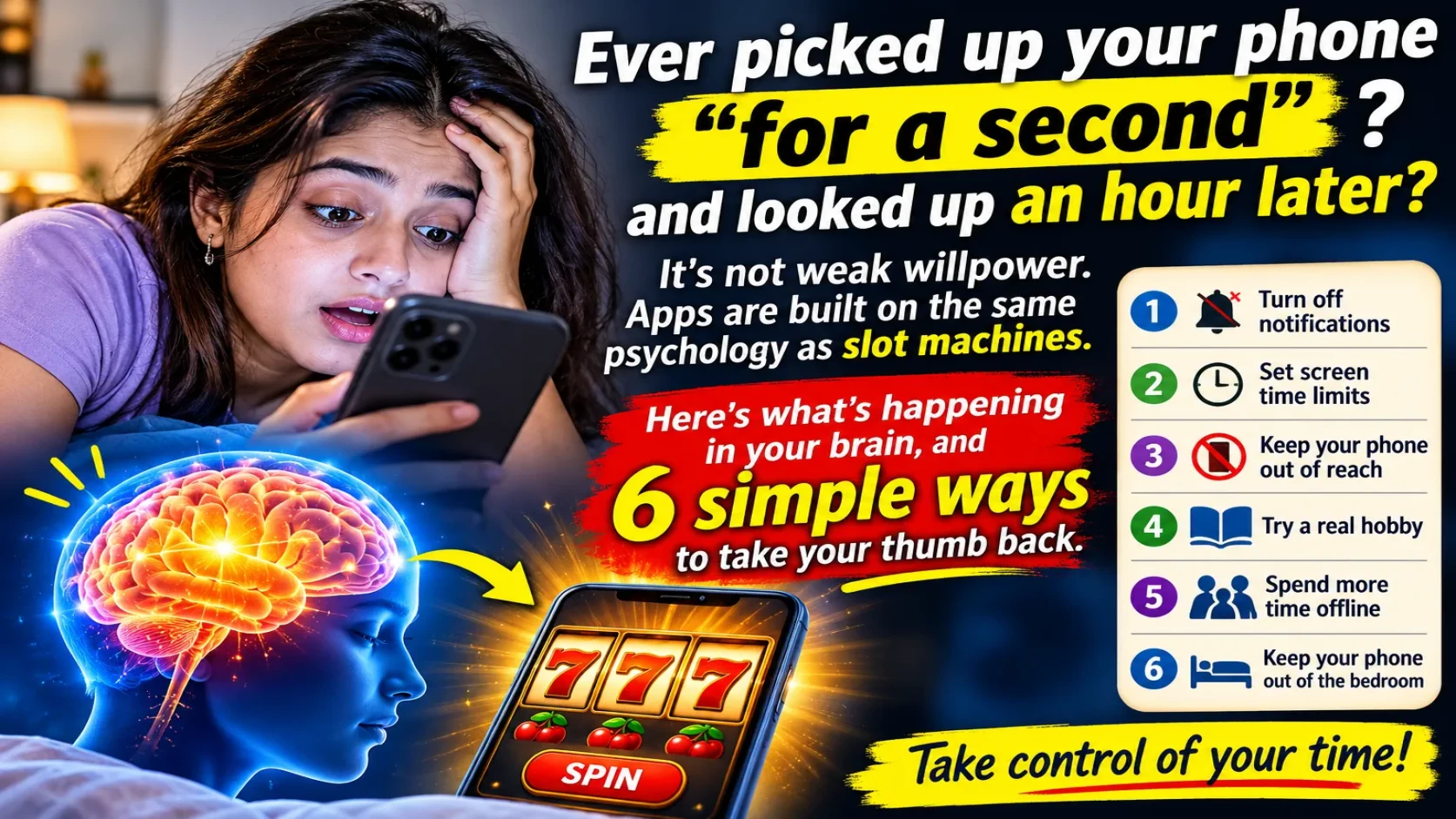
You open your phone to check one message. Forty minutes later, you're watching a video of someone repairing an old knife. You don't even remember how you got there.
Sounds familiar? It happens to many of us. It's not because you're lazy or have no self-control. Social media apps are designed in ways that make us want to keep watching.
The slot machine in your pocket
In the 1950s, psychologist B.F. Skinner discovered that animals kept trying to get rewards when those rewards came at unexpected times. They didn't know when they would get the next reward, so they kept trying.
This is the same idea used in slot machines at casinos.
Social media works in a similar way. Most videos may be ordinary, but suddenly you find something funny, surprising, interesting, or exciting. You never know what the next video will bring, so you keep scrolling, hoping to find something better.
Your brain wants to know what's next
Dopamine is often called the "pleasure chemical," but it also plays an important role in making us want things and looking forward to rewards.
When you scroll through social media, your brain keeps asking, "What will I see next?"
You may not even be enjoying the videos anymore, but you still keep scrolling because you hope the next one will be interesting. This feeling of wanting more can make it difficult to stop.
There is no stopping point
Earlier, when you read a newspaper, you eventually reached the last page. When you watched TV, the programme ended. There was a natural point to stop.
Social media changed that with infinite scrolling. You can keep moving down the feed, and new content keeps appearing.
There is no last page, no finish line, and no message telling you that you've seen enough. You have to decide when to stop on your own, which is not always easy.
Other tricks that keep you scrolling
- Autoplay: The next video starts automatically, so you don't have to do anything to keep watching.
- Notifications: A sound or pop-up makes you feel that something important has happened and you should check it.
- Likes and streaks: Getting likes feels good, while losing a streak can make you feel bad.
- FOMO (Fear of Missing Out): You worry that you might miss something funny, important, or something your friends are talking about.
- Comparison: You see other people's photos, achievements, and happy moments and start comparing them with your own life.
Teenagers may feel this pressure even more because friendships, social acceptance, and fitting in are very important during those years. But adults are affected too, especially when they are tired, stressed, or looking for a way to escape their daily problems.
Is scrolling always bad?
No. Social media can help us learn new things, stay connected with friends, enjoy entertainment, and discover useful information.
The problem is when you keep scrolling without even wanting to. You may not be enjoying it, yet you continue. Afterwards, you might feel tired, waste time, or regret not doing something more useful.
Ask yourself one simple question: Am I using my phone because I want to, or am I just scrolling without thinking?
6 simple ways to control your scrolling habit
1. Turn off unnecessary notifications
Keep notifications for calls and messages from people you care about. Turn off alerts from apps that constantly ask you to come back.
2. Make apps harder to open
Move social media apps away from your home screen or log out after using them. A few extra steps can help you stop opening them automatically.
3. Set a time limit
Use your phone's screen-time settings to limit how long you spend on social media each day. Try to follow the limit instead of repeatedly ignoring it.
4. Keep your phone away from your bed
Avoid scrolling just before sleeping or immediately after waking up. Charge your phone away from your bed and use a regular alarm clock if possible.
5. Try black-and-white mode
Changing your screen to grayscale removes bright, attractive colours and may make scrolling less tempting.
6. Find something else to do
Don't just stop scrolling—replace it with something enjoyable. Listen to music, read a book, take a walk, talk to someone, or do something you like. If you leave yourself bored with nothing to do, you may pick up your phone again.
Social media platforms are designed by teams of people who understand how to keep users interested for as long as possible. So, stopping isn't always as easy as simply saying, "I will use my phone less."
But once you understand why you keep scrolling, you can start making small changes to regain control of your time.
Next time you find yourself scrolling without a reason, pause for a moment and ask:
Do I really want to keep watching, or am I just doing it out of habit?
Sometimes, that one question is enough to put your phone down.
Choose an image
Featured Article

For years, the default expectation after Class 12, especially for science students has been simple: clear JEE for engineering or clear NEET for medicine. If you didn't fit into those two boxes, it often felt like you were out of options. How to Choose the Right Path.
That narrative is completely outdated. Read More

What if the world's largest river wasn't on the ground?
When people think of the Amazon, they imagine a vast jungle filled with exotic wildlife, giant trees, and the mighty Amazon River. But scientists have discovered something even more astonishing hidden above the forest. A massive invisible rivers flowing through the sky. Read More
বৃক্ষছায়ায় জ্ঞানের আলোকবর্তিকা: প্রাচীন ভারতীয় শিক্ষা দর্শনের গূঢ়তত্ত্ব Read More

A brief overview of the village where Batukeshwar Dutt was born, its historical significance and how to visit. Read More

অনেক বছর ধরে প্রচলিত একটি ধারণা মানুষ তার মস্তিষ্কের মাত্র ১০% ব্যবহার করে। আধুনিক স্নায়ুবিজ্ঞান বলছে, এটি সম্পূর্ণ ভুল। আমরা আসলে আমাদের মস্তিষ্কের প্রায় সব অংশই ব্যবহার করি, শুধু একসঙ্গে নয়। প্রতিটি অঞ্চল নির্দিষ্ট কাজের জন্য দায়ী, কোনো অংশ ভাষা বোঝে, কোনো অংশ পরিকল্পনা করে, আবার অন্য অংশ আবেগ বা চলাফেরার নিয়ন্ত্রণে থাকে। Read More