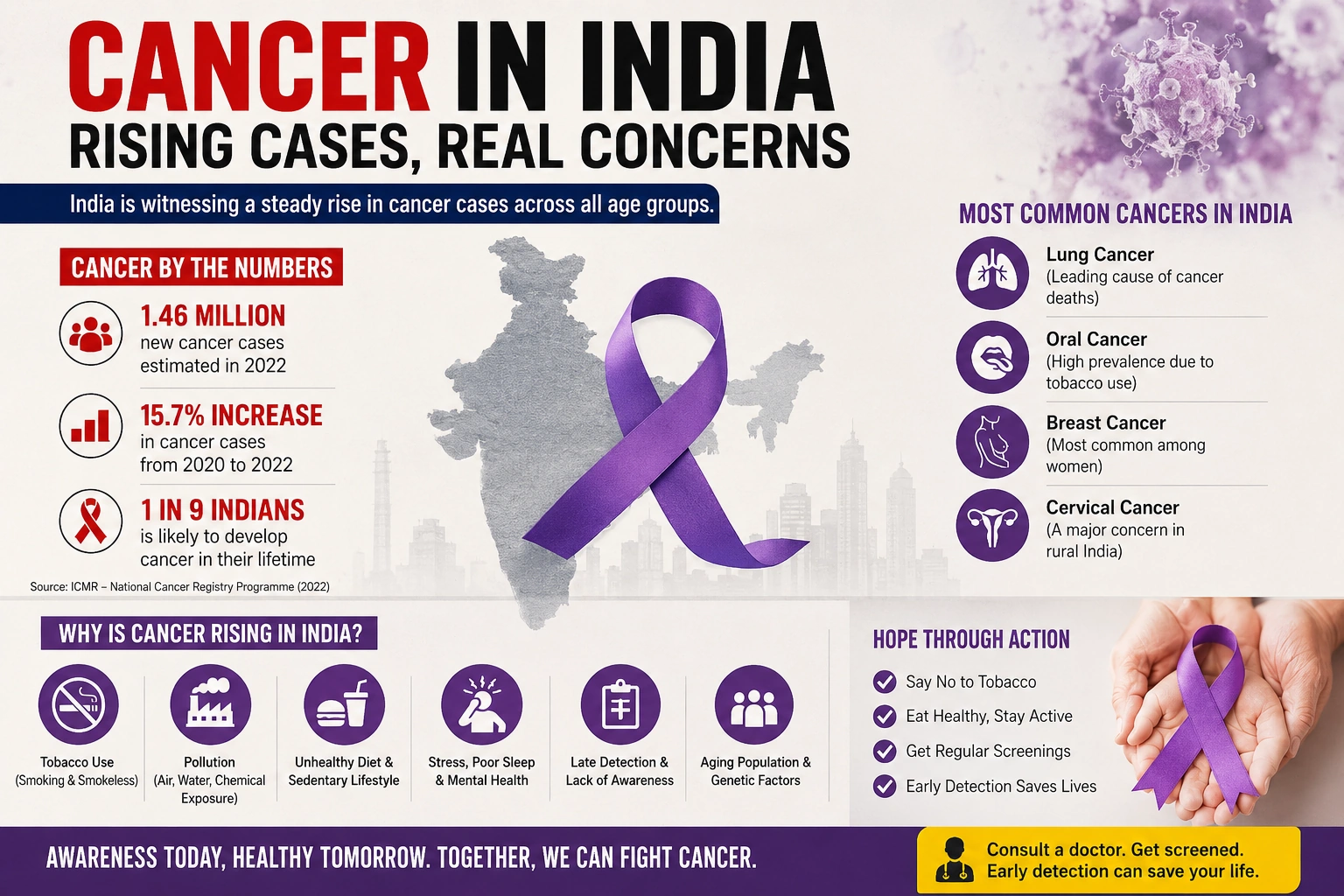
A few years ago, cancer was often seen as a disease that affected mostly older people. Today, however, it feels like we hear about cancer everywhere—among relatives, colleagues, neighbors, and even young adults. Stories of people in their 20s, 30s, and 40s being diagnosed seem more common than ever.
So, This raises an important question: Is cancer really increasing in India, or are we simply getting better at finding it?
The answer is more complex than many social media posts suggest.
Is Cancer Actually Increasing?
The short answer is yes, cancer cases are increasing in India.
However, part of this increase comes from better detection. Modern diagnostic tools such as CT scans, MRIs, biopsies, and cancer screening programs help doctors identify cancers that might have gone unnoticed in the past.
Years ago, many patients-- especially in smaller towns and rural areas were never formally diagnosed. Today, improved access to healthcare means more cases are being recorded.
But experts agree that the rise is not just about better detection. The actual number of people developing cancer is also growing.
Tobacco Remains India's Biggest Cancer Risk
Despite growing awareness, tobacco continues to be one of the leading causes of cancer in India. And it's not just cigarettes. Products such as bidis, gutkha, khaini, zarda, and smokeless tobacco are widely used across the country. These products significantly increase the risk of cancers of the mouth, throat, esophagus, and lungs.
In fact, India has one of the world's highest burdens of oral cancer, largely linked to tobacco consumption.
The Role of Pollution
Many Indian cities regularly rank among the world's most polluted.
Long-term exposure to polluted air can damage the lungs and has been linked to an increased risk of lung cancer. Air pollution is not the only concern-- contaminated water, industrial waste, and exposure to certain chemicals may also contribute to long-term health risks.
Pollution alone does not explain the entire cancer burden, but it is increasingly being viewed as an important piece of the puzzle.
Have Our Food Habits Changed?
Think about how much the average Indian diet has changed over the last few decades.
Traditional home-cooked meals are increasingly competing with:
- Ultra-processed foods
- Sugary beverages
- Fast food
- Packaged snacks
- High-fat and high-salt products
No single food causes cancer directly. However, diets associated with obesity, diabetes, and chronic inflammation can increase the risk of several cancers over time.
As lifestyles become more urban and sedentary, these risks become more significant.
Why Are Younger People Getting Diagnosed?
Perhaps the most worrying trend is the growing number of younger adults being diagnosed with certain cancers.
Researchers believe several factors may be contributing:
- Better awareness and earlier diagnosis
- Sedentary lifestyles
- Rising obesity rates
- Poor sleep habits
- Environmental exposures
- Dietary changes
- Genetic factors
Scientists are still studying why some cancers appear to be occurring more frequently in younger populations. While there is no single explanation, lifestyle and environmental changes are receiving increasing attention.
Is Stress Causing Cancer?
Stress is often blamed for almost every modern health problem, including cancer.
The reality is more nuanced. There is currently no strong evidence that stress directly causes cancer. However, chronic stress can influence behaviors that increase risk, such as smoking, unhealthy eating, lack of exercise, poor sleep, and excessive alcohol consumption.
In that sense, stress may indirectly contribute to an unhealthy lifestyle.
What Can We Do?
Not every cancer can be prevented, but many risk factors can be reduced.
Some practical steps include:
- ✅ Avoid all forms of tobacco
- ✅ Stay physically active
- ✅ Eat more fruits and vegetables
- ✅ Limit ultra-processed foods
- ✅ Maintain a healthy weight
- ✅ Get adequate sleep
- ✅ Attend recommended health screenings
- ✅ Consult a doctor if you notice unusual symptoms
Cancer is becoming one of India's biggest public health challenges. The increase is driven by a combination of population growth, longer life expectancy, lifestyle changes, environmental factors, and improved detection. The good news is that many cancers are highly treatable when found early. Awareness, prevention, and timely diagnosis remain our strongest tools.
Rather than asking whether cancer is increasing, perhaps the more important question is: Are we doing enough to reduce the risks we can control?
Choose an image
Featured Article

For years, the default expectation after Class 12, especially for science students has been simple: clear JEE for engineering or clear NEET for medicine. If you didn't fit into those two boxes, it often felt like you were out of options. How to Choose the Right Path.
That narrative is completely outdated. Read More

What if the world's largest river wasn't on the ground?
When people think of the Amazon, they imagine a vast jungle filled with exotic wildlife, giant trees, and the mighty Amazon River. But scientists have discovered something even more astonishing hidden above the forest. A massive invisible rivers flowing through the sky. Read More

বৃক্ষছায়ায় জ্ঞানের আলোকবর্তিকা: প্রাচীন ভারতীয় শিক্ষা দর্শনের গূঢ়তত্ত্ব Read More

A brief overview of the village where Batukeshwar Dutt was born, its historical significance and how to visit. Read More

অনেক বছর ধরে প্রচলিত একটি ধারণা মানুষ তার মস্তিষ্কের মাত্র ১০% ব্যবহার করে। আধুনিক স্নায়ুবিজ্ঞান বলছে, এটি সম্পূর্ণ ভুল। আমরা আসলে আমাদের মস্তিষ্কের প্রায় সব অংশই ব্যবহার করি, শুধু একসঙ্গে নয়। প্রতিটি অঞ্চল নির্দিষ্ট কাজের জন্য দায়ী, কোনো অংশ ভাষা বোঝে, কোনো অংশ পরিকল্পনা করে, আবার অন্য অংশ আবেগ বা চলাফেরার নিয়ন্ত্রণে থাকে। Read More