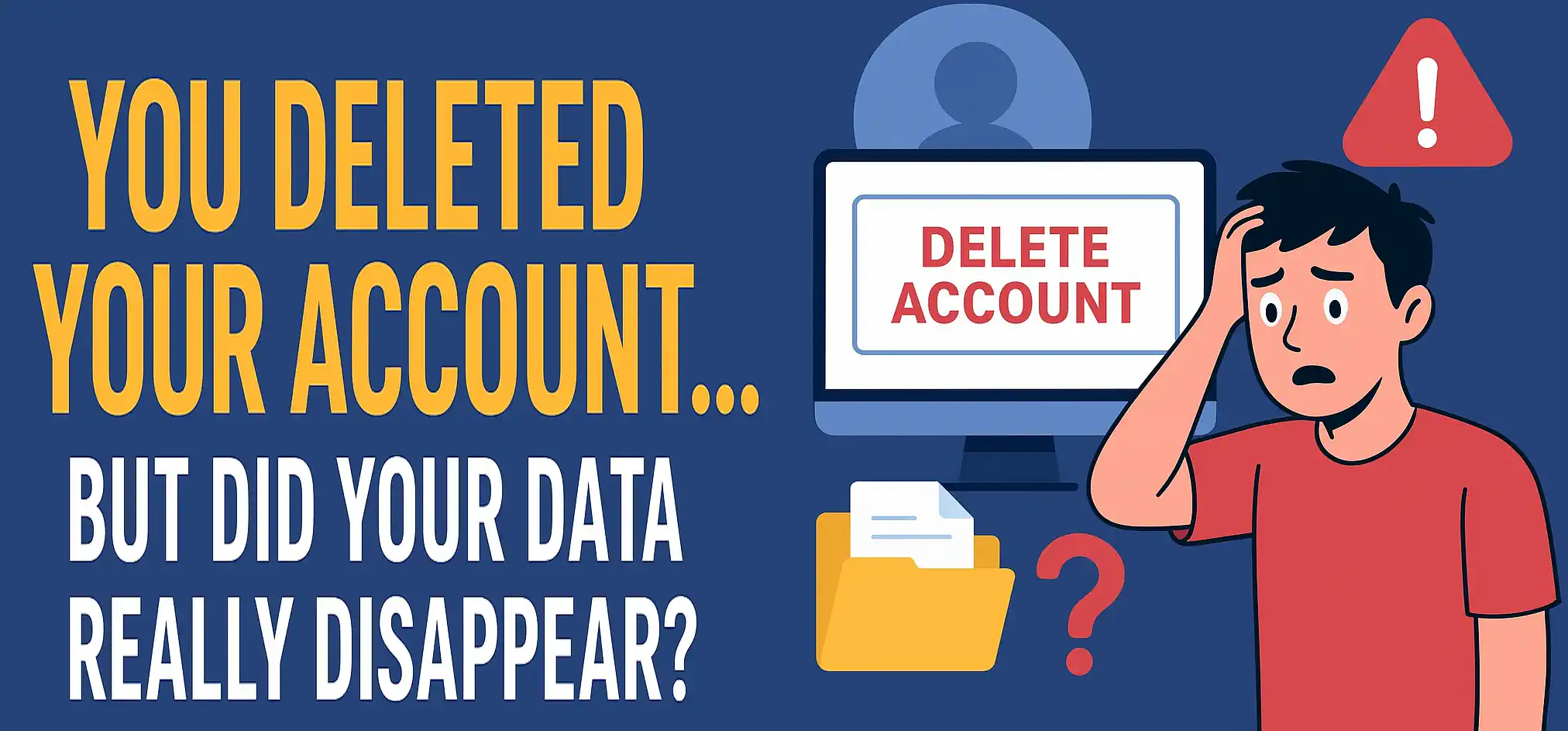
So, you finally hit that “Delete Account” button and maybe even felt a little thrill.
No more notifications. No more emails. No more data trails… right?
Wrong.
What actually happens behind the scenes after you delete your account might surprise you. Let’s peel back the curtain on what really happens to your personal data once you walk away.
Step 1: Deactivation Isn’t Deletion (Big Difference!)
Most websites don’t nuke your data instantly. First, they deactivate your account, hiding it from public view but keeping everything on their servers. So, your data is still sitting there, waiting… just invisible to everyone else.
Only when you officially request permanent deletion does the countdown to total data wipe begin.
Step 2: The “Grace Period” - A Digital Waiting Room
Think your info vanishes right away? Nope. Platforms usually hold your data for 30 to 90 days. A safety net in case you regret your decision. During this grace period, your profile, photos, and posts are in limbo, quietly stored on company servers. Once the timer runs out, that’s when the real cleanup starts.
Step 3: What Actually Gets Deleted
When deletion finally kicks in, here’s what’s usually erased:
✅ Your profile info (name, email, photos, bio)
✅ Your posts, uploads, and comments
✅ Your messages (sometimes)
✅ Your browsing and activity logs
Essentially, everything that defines you as a user, gone from the main system.
Step 4: But Wait… Some Data Still Stays 😬
Not everything vanishes. Some pieces of your digital self can linger for months or even years:
🧾 Billing records (kept for tax and legal reasons)
🛡️ Security logs (to prevent fraud)
💾 Backups (temporary, but still there)
💬 Messages you sent to others (they remain in their inbox)
These leftovers are usually locked down and auto-deleted later, but yes they exist.
Step 5: The Third-Party Twist
Even if your account is gone, third-party partners (ad networks, payment gateways, analytics tools) might still hold copies of your data.
Unless the main platform notifies them to delete it, your info could live on in other corners of the internet. You might need to contact those services directly to truly disappear.
Step 6: The Ghost of You on Google 👻
Search your name after deleting your account - shocked to still see it?
That’s because Google and other search engines cache old data. Those cached pages can hang around for weeks or months. But don’t panic. You can file a quick “Remove outdated content” request with Google to speed up the process.
Step 7: Can You Check If You’re Really Gone?
Some platforms make it easy to confirm deletion:
- They’ll send a confirmation email.
- Some let you download your data before deletion.
- Under GDPR or CCPA, you can even ask for proof of erasure. Your official “Right to Be Forgotten.”
Final Thoughts: Deleting Doesn’t Mean Disappearing
Hitting “delete” is empowering -- but it’s not instant magic. Data lives longer than most people realize, thanks to backups, legal logs, and synced third-party systems.
So before you say goodbye:
- Download your data.
- Revoke connected app permissions.
- Clear caches and cookies.
Then and only then can you rest easy knowing you’ve really taken control of your digital privacy.
Deleting your account feels final, but in reality, your data goes on a slow journey from “invisible” → “pending deletion” → “permanently erased.”
Stay smart. Stay private. Because in the online world, nothing truly disappears without a fight.
Choose an image
Featured Article

For years, the default expectation after Class 12, especially for science students has been simple: clear JEE for engineering or clear NEET for medicine. If you didn't fit into those two boxes, it often felt like you were out of options. How to Choose the Right Path.
That narrative is completely outdated. Read More

What if the world's largest river wasn't on the ground?
When people think of the Amazon, they imagine a vast jungle filled with exotic wildlife, giant trees, and the mighty Amazon River. But scientists have discovered something even more astonishing hidden above the forest. A massive invisible rivers flowing through the sky. Read More
বৃক্ষছায়ায় জ্ঞানের আলোকবর্তিকা: প্রাচীন ভারতীয় শিক্ষা দর্শনের গূঢ়তত্ত্ব Read More

A brief overview of the village where Batukeshwar Dutt was born, its historical significance and how to visit. Read More

অনেক বছর ধরে প্রচলিত একটি ধারণা মানুষ তার মস্তিষ্কের মাত্র ১০% ব্যবহার করে। আধুনিক স্নায়ুবিজ্ঞান বলছে, এটি সম্পূর্ণ ভুল। আমরা আসলে আমাদের মস্তিষ্কের প্রায় সব অংশই ব্যবহার করি, শুধু একসঙ্গে নয়। প্রতিটি অঞ্চল নির্দিষ্ট কাজের জন্য দায়ী, কোনো অংশ ভাষা বোঝে, কোনো অংশ পরিকল্পনা করে, আবার অন্য অংশ আবেগ বা চলাফেরার নিয়ন্ত্রণে থাকে। Read More